

In this section we address the topic of “Segmented Gamma Scanning” for users. It is aimed at
- individuals who are responsible for conducting segmented gamma scan measurements or will be in the future,
- representatives from authorities and assessors who need to evaluate the results of segmented gamma scan measurements, and
- interested parties who want to learn more about the practical execution of segmented gamma scan measurements.
What can you expect in this section?
In the following, we will also get to know the essential mathematical models (i.e., formulas) that are used in practice for the evaluation of measurement data. We will discuss their application and, above all, their validity without showing their mathematical derivations. These can be followed in detail through provided links in the “Experts” section if interested.
We will first take a detailed look at the various components of a segmented gamma scanner. These include among others
- the mechanical components along with
- their drive and control components,
- the gamma spectrometry system,
- the collimator, and
- other optional components.
It should be noted here that there is NO single segmented gamma scanner. Depending on the specific question, the manufacturer, and other boundary conditions, such as available space, required throughput, or integration into a (existing) process system, the setups can differ significantly in their design. However, the basic principles of all systems are the same. From the following descriptions, the necessary design of a segmented gamma scanner for a specific application case can be easily derived.
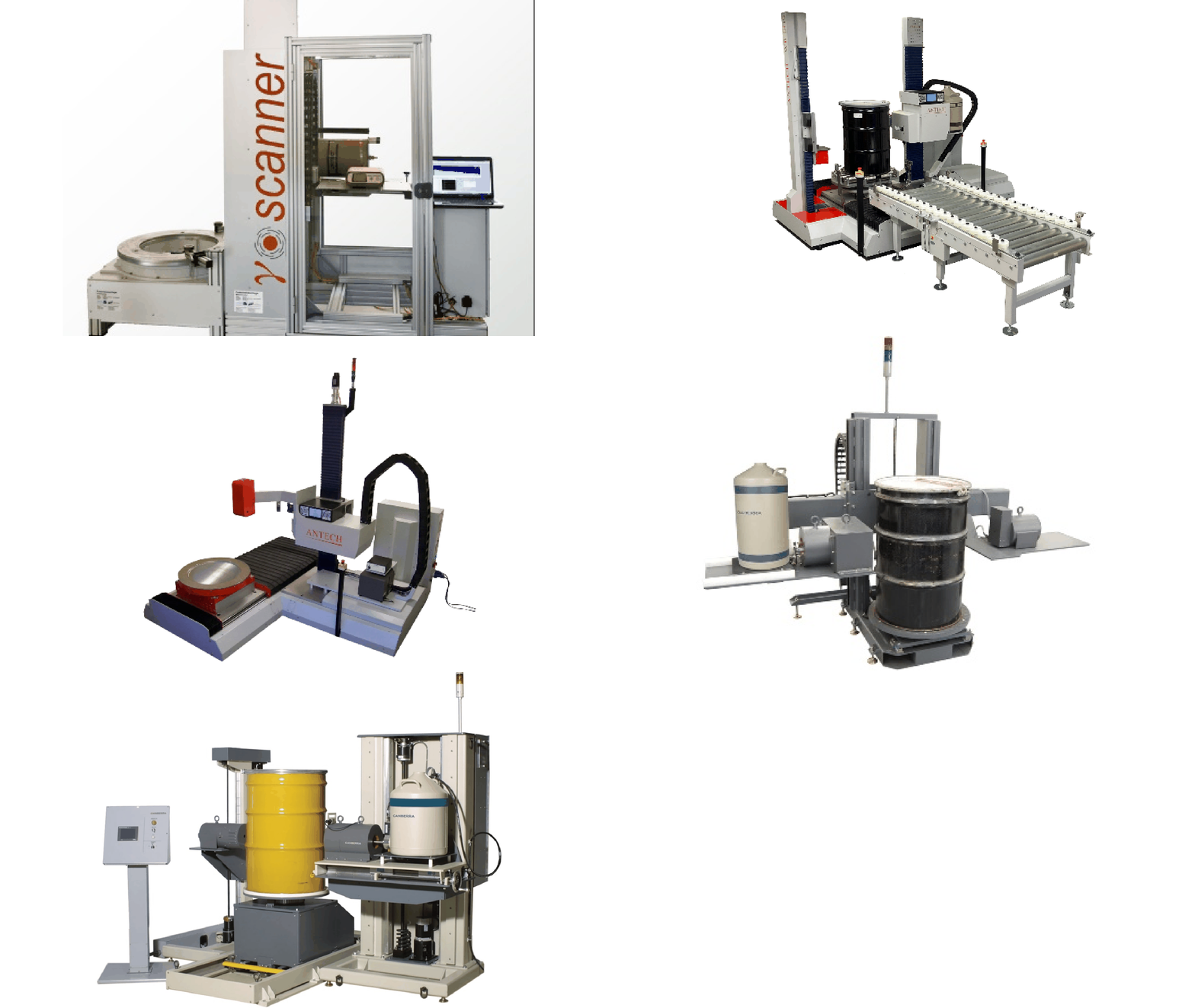
Subsequently, we will look at the execution of segmented gamma measurements. This starts with the preparatory steps, such as the calibration of the measurement system and its components, the compilation and evaluation of available a priori information, the selection of appropriate measurement parameters, the start of the actual measurement, and the measures to be considered during this process.
Upon completion of the measurement, the evaluation and further processing of the data begins. Here we will discuss the analysis of the data and the creation of various spectra and distributions before a detailed treatment of the evaluation topic begins. This section covers various evaluation methods, discusses their respective application areas and limitations. An important and often neglected topic is the determination of measurement uncertainties, which will be addressed extensively and specifically in terms of practical application.
