

Under the umbrella term segmented gamma scanning (SGS), all gamma spectrometric methods are summarized, which "scan" a measurement object in some way, i.e., perform gamma spectrometric measurements at various positions of the measurement object and store the measured gamma spectra for subsequent evaluation.
For the gamma-spectrometric characterization of containers from nuclear facilities, the following two measurement methods have become established:
the respective areas of application and limitations of which will be outlined below.
Gamma measurement in open geometry
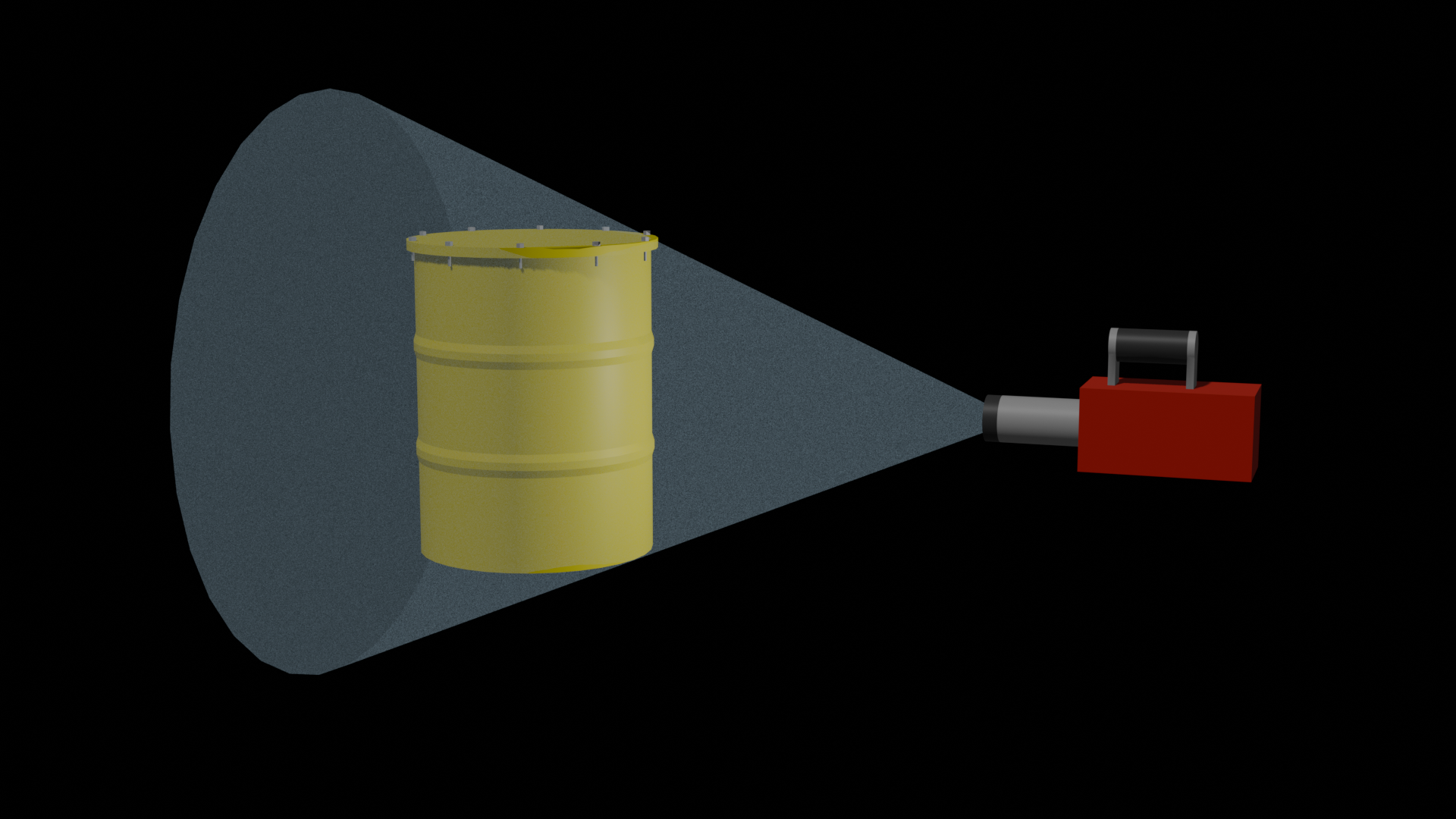
The measurement in the so-called open geometry is a very simple and quick method for determining the activities of gamma-emitting radionuclides in containers, such as waste containers. For this purpose, a radiation detector (e.g., a germanium detector) is positioned at half the height of the container. The distance between the detector and the container should be chosen so that the detector can "see" the entire container, i.e., gamma radiation can theoretically enter the detector from every area of the container.
Note:
Additional shielding around the detector or the use of a collimator with a wide opening angle that restricts the "view" of the measurement object can minimize unwanted contributions to the measured gamma spectrum from the surroundings.
The evaluation of the measured gamma spectrum then allows for an identification of the radionuclides contained in the container (qualitative evaluation) as well as the calculation of the corresponding activities (quantitative evaluation).
Quantification is based on the proportionality of the measured count rate Z (= net peak area / live time) of a characteristic peak with the activity A of the radionuclide:
\[ A \sim Z = cal \cdot Z\]
The proportionality factor cal, i.e., the quantity by which the count rate Z must be multiplied to obtain the activity A, can be determined by
- calibration measurements on an identical measurement object with known activity A,
- measurements with calibration sources and inclusion of model descriptions of the measurement setup, or
- simulation calculations
to be conducted.
A correct quantitative determination of the activities, however, assumes several conditions regarding the contents of the container:
The contents must
- completely fill the container,
- be homogeneous (this applies to the material and activity distribution), and
- the density and/or material composition in the container must be known.
If these conditions are not met, the calculated activities can at worst deviate by several orders of magnitude from the actual values!
Advantages and disadvantages of measurement in open geometry
Advantages
- low requirements for the measurement system (an adjustable height detector system is sufficient; if necessary, a few euro pallets or similar can be used as a base for positioning the detector);
- relatively high effectiveness and thus short measurement times, as the detector always sees the entire container;
- the method can be relatively easily adapted to different container types (cylindrical, barrel-shaped, rectangular, etc.).
Disadvantages
- for a correct quantitative determination of activity, numerous conditions must be met;
- these conditions cannot be verified by the measurement and must therefore be verifiable through a priori information or other measurement methods (e.g., radiography, tomography).
If the measurement setup is supplemented by a rotating table, the influence of (smaller) deviations from a homogeneous distribution of the material and/or activities can be reduced by rotating the measurement object during the measurement, meaning that any existing inhomogeneities have less impact on the quantitative evaluation of the measurement data compared to a stationary point measurement, and averaging takes place.
Notes:
- This measurement method corresponds to a "normal" gamma measurement but is generally assigned to the field of segmented measurement methods (measurement with one segment and one sector: point measurement).
- If the barrel is placed on a rotary table and continuously rotated during measurement, the influence of slight inhomogeneities on the result can be reduced (measurement with one segment and one sector: disk scan).
- If a rotation of 360° is divided into individual equal sections and a separate gamma spectrum is measured and stored for each section, a rough statement about the angular-dependent homogeneity can be made through the evaluation of the individual spectra (measurement with one segment and N sectors: disk scan).
- If a dose rate measurement probe is used instead of a gamma detector, activities can be calculated from the dose rate measurement value with known composition of the radionuclides (i.e., knowledge of the nuclide vector).
Collimated measurement
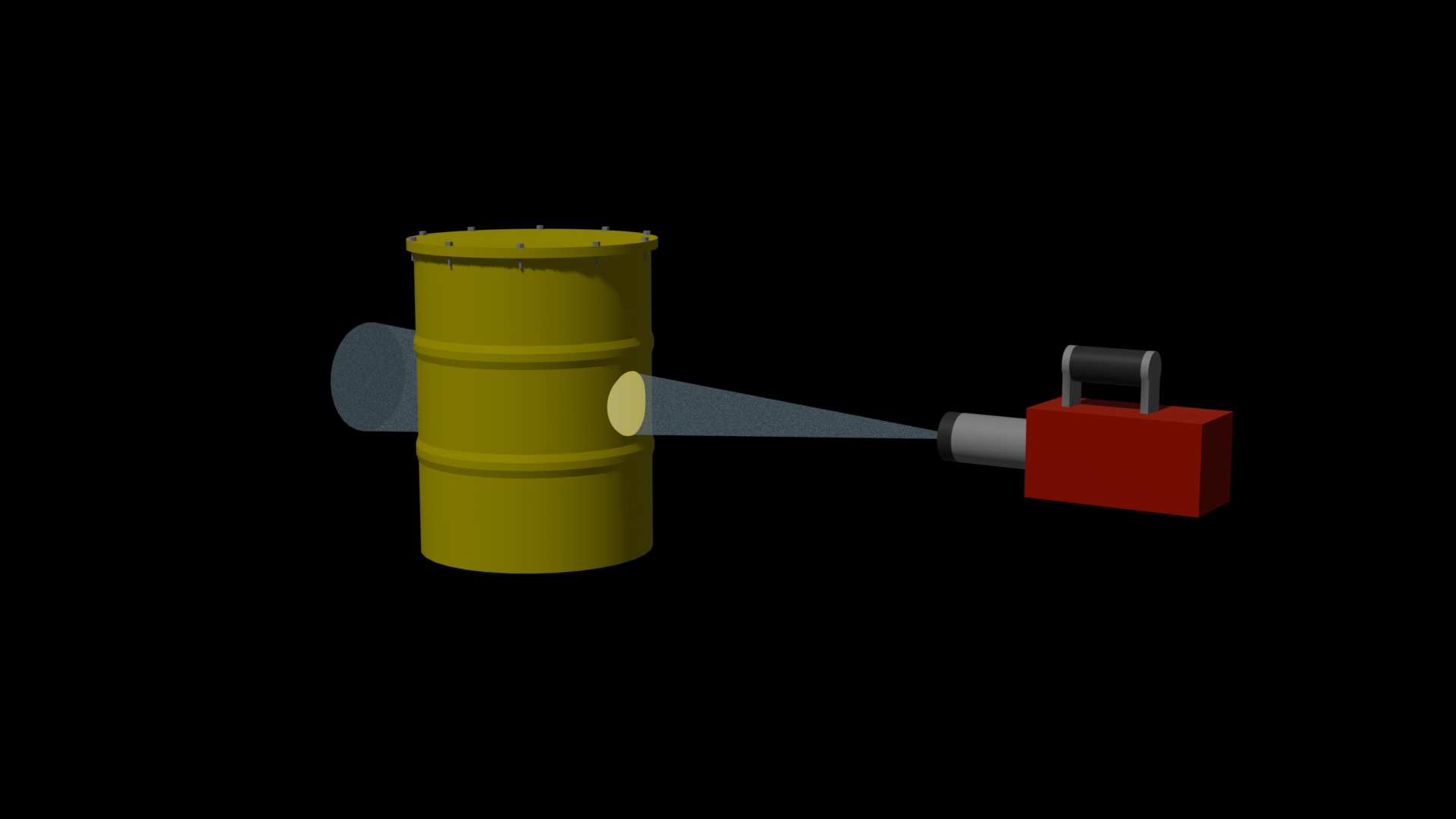
In a collimated measurement, the detector's field of view is restricted by a collimator. Depending on the shape of the collimator (cylindrical, rectangular, conical, etc.), the detector "sees" only a specific area of the object being examined at one position, i.e., the detector only registers gamma radiation emitted by radionuclides located in this area of the container.
In practice, however, the task usually requires a qualitative and quantitative determination of the radioactive material in the entire container or in one or more layers of the container. An obvious method for this is to measure the container at as many different positions as necessary to fully cover the required area of the container with the individual fields of view.
For approaching the various measurement positions, suitable mechanics with control and data acquisition are required (although manual positioning would generally also be possible). Such a measurement system is referred to as a segmented gamma scanner.
Depending on the movement possibilities of the axes, the measurement object can be "scanned" in different ways. The individual movement sequences (scan modes) are assigned specific names. The approach to individual measurement positions can occur discretely (so-called start-stop mode) with data acquisition in a stationary position or continuously, meaning that data acquisition occurs while moving between two measurement positions, i.e., for a measurement interval.
In every measurement position or measurement interval, a complete gamma measurement is performed and the respective gamma spectrum (the so-called single spectrum) is stored.
For qualitative evaluation, i.e., the identification of the radionuclides contained in the container, all single spectra are usually summed, and the characteristic peaks present in the resulting summed spectrum are identified.
Important:
After completing the qualitative evaluation of a spectrum, each peak must be identified (exception: if the specific task requires otherwise).
Additionally, there is still the possibility of evaluating the individual spectra. This may allow the detection of characteristic lines of radionuclides that are masked in the summed spectrum by contributions from other nuclides and are thus not visible. However, in practice, the measurement time for a single spectrum is relatively short, which can lead to large statistical uncertainties.
The storage of the measured single spectra enables the creation of spatial distributions (OVT) for the various characteristic lines of the detected (identified) radionuclides and the dead time distribution after the measurement is completed. Based on these distributions, a statement about the homogeneity of the activity or matrix distribution in the container can be made. On this basis, a suitable evaluation procedure can be selected or, if necessary, supplementary gamma-spectrometric measurements can be carried out.
Depending on the chosen evaluation method, a suitable efficiency calibration is required for quantitative evaluation, which links the count rate Z determined in the measurement for a characteristic line (i.e., an energy) of an identified radionuclide with the activity A of the radionuclide to be determined. For the efficiency calibration,
- measurements with calibration sources including model descriptions of the measurement setup, or
- simulation calculations
can be performed.
Advantages:
- the entire measurement object is captured;
- based on the spatial distributions, (qualitative) statements can be made about the homogeneity of the activity or density distributions;
- the dead time distribution provides indications of the presence of beta emitters (bremsstrahlung);
- selection of a suitable evaluation method based on the OVTs;
- (qualitative) information for the assumptions of measurement uncertainties.
Disadvantages:
- increased effort for hardware and control (acquisition costs);
- increased time effort for the measurement;
- increased maintenance effort;
- higher demands on operating or evaluation personnel;
